Guide · Guide to north Tenerife
What to see in San Juan de la Rambla, from the old town to the sea
What to see in San Juan de la Rambla: the old town, Calle de La Alhóndiga, Charco de La Laja, Las Aguas, La Vera, the gofio mill and the Fiesta del Humo.
- 5 minread
- 2 November 2026checked
- 23sources
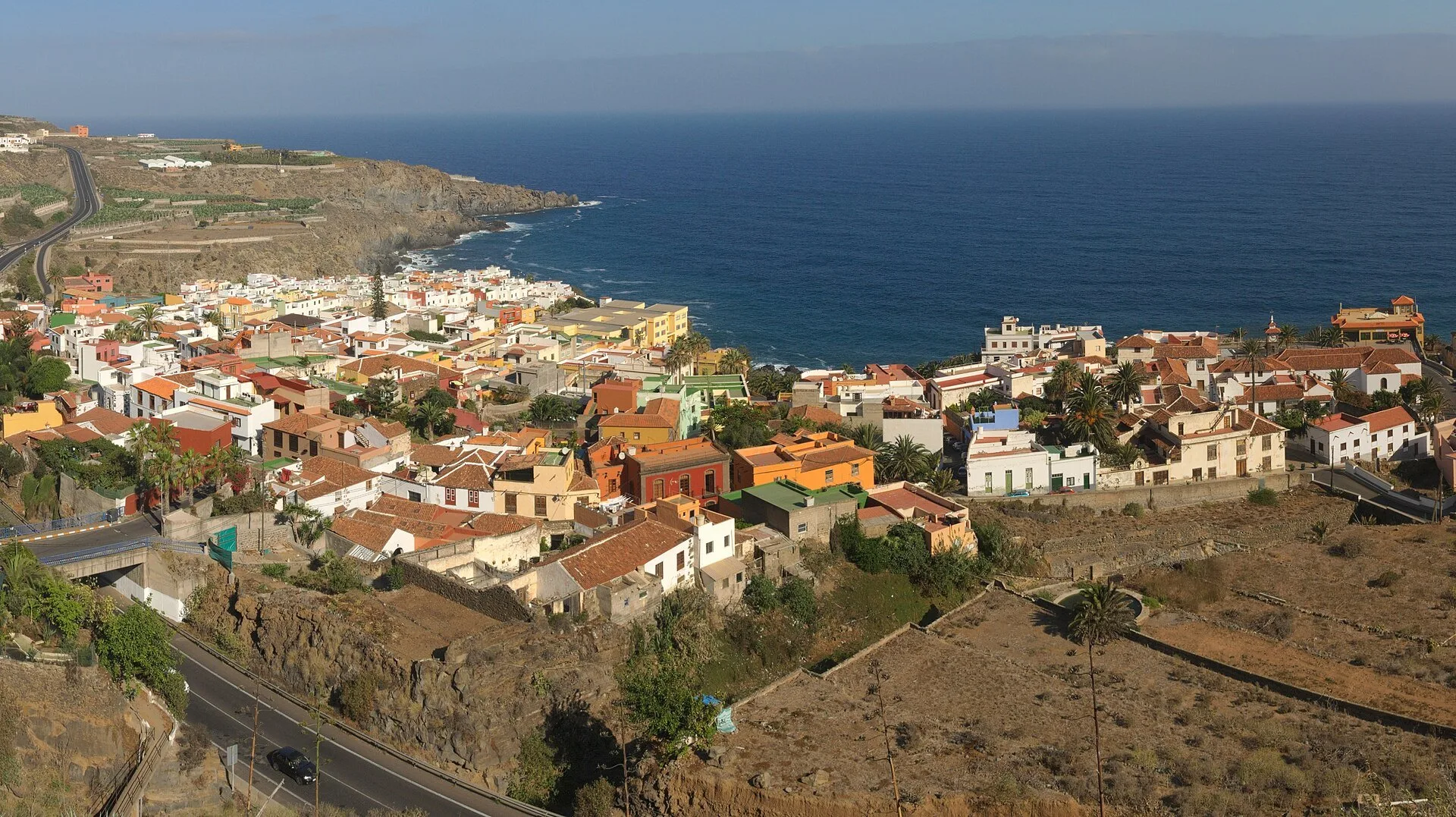
San Juan de la Rambla is a small municipality on Tenerife's north coast, between Los Realejos and La Guancha. What there is to see sits right by the sea: an old town listed as a Site of Cultural Interest, with Calle de La Alhóndiga and its seventeenth- and eighteenth-century houses, and, at the end of one street, the Charco de La Laja rock pool. Next door lie the Las Aguas district, with its pebble beach, and La Rambla, with its Rosario chapel. Higher up are La Vera, the Ruiz ravine and the hills.
The old town
It was founded by a Portuguese settler in the early sixteenth century. He built a chapel to San Juan Bautista, and families drawn by the good farmland settled around it. The Cabildo's catalogue of listed heritage notes that the town was once called San Juan del Malpaís and dates that first chapel to around 1530, beside the Camino Real, the old island road. In 1925 Alfonso XIII granted it the title of Villa.
The old town is listed as a Historic Ensemble. It is laid out around the church of San Juan Bautista, from the sixteenth century, and Plaza Rosario Oramas. The surviving houses date from the seventeenth and eighteenth centuries: stone walls, tiled roofs and wooden balconies. Facing the church square is the Casa de los Alonso del Castillo, from the late eighteenth century, with a stone cornice under the eaves and a courtyard with a wooden staircase. No official source gives the church's opening hours.
Calle de La Alhóndiga
This is the cobbled street worth walking slowly. At number 1 stands the Casa La Alhóndiga, from the early seventeenth century. It served as a grain store, a meeting hall and a prison, and was the first town hall. Later alterations left little more than its walls.
Opposite, at number 4, is the Casa de los Delgado Oramas, from the second half of the eighteenth century. Look for its covered balcony, four sections long on double corbels. Inside it keeps a stone-paved courtyard with a wooden gallery and a period kitchen with oven and chimney.
Charco de La Laja
At the end of one of the old-town streets, lava formed a basin that fills with seawater. You can see it from the viewpoint of the same name and reach it down a path. The swell can be strong: check the sea first. Tides, facilities and warnings are in the natural pools guide.
Natural pools in north Tenerife
Las Aguas and La Rambla, by the sea
The town hall calls Las Aguas the municipality's door to the sea. It has a promenade, bars and restaurants and Las Aguas beach: about 120 metres of pebbles. Go as the tide drops, when the big rocks appear. The waves are strong, so take great care if you swim.
La Rambla sits at the mouth of the Ruiz ravine, among banana plantations. Above it stands the chapel of Nuestra Señora del Rosario, from the seventeenth century, built on a private estate with the bishop's permission. It has a small choir, a pulpit and a painting of the Virgin over the altar. The district's square is just over 50 metres above the sea, and from here you look along the coast of Las Aguas and Los Realejos.
La Vera, San José and Los Quevedos
Heading uphill, La Vera is the largest district. It has the San Felipe Neri chapel beside its square, the old washing places and views over the Ruiz ravine. From El Mazapé you see the old town and the north coast. Higher still, in the San José district, stands the church of San José, listed as a Monument: a rectangular plan, a hipped roof of Arabic tiles and a late eighteenth-century altarpiece. On the same hillside lies Los Quevedos, some fifteen rural houses with basalt walls, also a listed site.
The Ruiz ravine and the gofio mill
The Ruiz ravine is part of the Los Campeches, Tigaiga and Ruiz Protected Landscape, which San Juan de la Rambla shares with Los Realejos; we cover it in the Los Realejos guide. On its left-hand slope is the Risco de las Pencas gofio mill, also known as the Ruiz or La Grieta mill. It was water-powered, worked until 1942 and has been a listed ethnological site since 2007.
Festivities
The 2026 local holidays were 24 June, San Juan Bautista, and 14 September, San José. October brings the Fiesta del Humo: at dusk, residents walk down with lit torches from the Risco de las Pencas to La Rambla. The name comes from the cloud of smoke the torches leave as they are put out in the square. It was revived in 2011; in 2026 it fell on 10 October. A few days earlier, the Remojo de los Chochos recalls how farmers left sacks of lupin beans (chochos) in La Rambla's rock pools to take on salt.
- Old town
- Listed historic ensemble · San Juan Bautista church, 16th century
- Calle de La Alhóndiga
- Casa La Alhóndiga (no. 1, 17th c.) and Delgado Oramas house (no. 4, 18th c.)
- Las Aguas beach
- Pebbles · about 120 m · strong waves
- Rosario chapel
- La Rambla · 17th century
- Risco de las Pencas mill
- Ruiz ravine · listed since 2007
- Local holidays 2026
- 24 June and 14 September
From Finca Julia
San Juan de la Rambla lies east of Icod, on the way to Los Realejos and Puerto de la Cruz. A simple plan: the old town and Calle de La Alhóndiga in the morning, Charco de La Laja if the sea is calm, and lunch in Las Aguas. In the afternoon, go up to La Rambla to look along the coast from the chapel. If you come in early October, ask about the Fiesta del Humo.
What to see in Puerto de la Cruz
What to see in Icod de los Vinos
Frequently asked questions
Can you swim in San Juan de la Rambla?
Yes, at Charco de La Laja and at Las Aguas beach. Both can have strong waves: check the sea and the tide before you go in.
What is the Fiesta del Humo?
A night-time walk down with lit torches from the Risco de las Pencas to the La Rambla district, in October. It was revived in 2011. Check each year's date on the town hall website.
Which is the old-town church?
San Juan Bautista, from the sixteenth century, around which the town grew. The church of San José is further uphill, in the district of the same name.
Finca Julia is a few minutes from all of this.
Check availability on Airbnb — Opens the official Airbnb listing in a new tabSources
- Ayuntamiento de San Juan de la Rambla — Inicio ↗
- Ayuntamiento de San Juan de la Rambla — Área de Turismo ↗
- Ayuntamiento de San Juan de la Rambla — Núcleos poblacionales ↗
- Ayuntamiento de San Juan de la Rambla — Charco de La Laja ↗
- Ayuntamiento de San Juan de la Rambla — Playa de Las Aguas ↗
- Ayuntamiento de San Juan de la Rambla — Área de Fiestas ↗
- Ayuntamiento de San Juan de la Rambla — Remojo de los Chochos y Fiesta del Humo 2026 ↗
- Turismo de Tenerife — San Juan de la Rambla ↗
- Turismo de Tenerife — San Juan de la Rambla (inglés) ↗
- Turismo de Tenerife — Casa La Alhóndiga ↗
- Turismo de Tenerife — Casa de los Delgado Oramas ↗
- Turismo de Tenerife — Casa de los Alonso del Castillo ↗
- Turismo de Tenerife — Ermita de Nuestra Señora del Rosario ↗
- Turismo de Tenerife — Iglesia de San José ↗
- Turismo de Tenerife — Los Quevedos ↗
- Turismo de Tenerife — Molino de gofio del Risco de las Pencas ↗
- Turismo de Tenerife — Playa de Las Aguas ↗
- Turismo de Tenerife — Charco de la Laja (inglés) ↗
- Turismo de Islas Canarias — Villa de San Juan de la Rambla ↗
- Turismo de Islas Canarias — Charco de La Laja ↗
- Tenerife ON (Cabildo) — Paisaje Protegido de Los Campeches, Tigaiga y Ruiz (inglés) ↗
- Cabildo de Tenerife — Catálogo de Bienes de Interés Cultural ↗
- Gobierno de Canarias — Festivos de los municipios de Canarias para 2026 ↗
Updated on: · Reviewed on:
This guide is written from a house in Icod.
Finca Julia is a Canarian house for four in the hills above the town. Availability and price are on the official listing.
Plans
Plans that pass through here
Experiences and itineraries that share places with this page.
- PlanFrom the volcano to the AtlanticUp to Teide in the morning, the whole island from La Rambleta at 3,555 metres, and down to swim at San Marcos in the afternoon. Only possible from the north.
- PlanBlack, blue and lavaThe black sand of San Marcos, the rock pools of El Caletón and the badlands of Chinyero: the coast and the volcano that made it, on a dry day without a swell.
- PlanA morning of mystery in IcodA 27,000-year-old lava tube, a tree whose age nobody knows and the port the lava swallowed in 1706. For travellers who come looking for stories.
- PlanA morning among dragon trees and stoneBreakfast in the old town, the dragon tree before the crowds, Icod on foot and Garachico for lunch. Four hours, six kilometres of driving.
Keep reading
The whole guide© Javier Sanchez Portero · CC BY-SA 3.0 5 min read
Towns near Icod: north Tenerife, town by town
© Noemi M. M. · CC BY-SA 4.0 7 min read
What to see in Los Realejos, from the old towns to the cliffs
© Mike Peel . · CC BY-SA 4.0 3 min read
The north's rock pools and natural pools, nearest first
Finca Julia · Icod de los Vinos
And at the end of the day,
the terrace.
An old Canarian house on the hillside, with the Atlantic in front. Availability and price are on the official Airbnb listing.