Guide · Guide to north Tenerife
What to see in La Orotava, the town of wooden balconies
What to see in La Orotava: the historic old town, La Concepción, the Casa de los Balcones, two free gardens and a free crafts museum, with official hours.
- 6 minread
- 30 October 2026checked
- 20sources
What you come to La Orotava for is the old town: cobbled streets, wooden balconies and manor houses, listed as a historic-artistic ensemble in 1976. Turismo de Tenerife suggests two to three hours for a first visit to the old town. On foot you can link the church of La Concepción, the Casa de los Balcones, the Town Hall, the church of San Agustín, the Liceo de Taoro and two free gardens, the Victoria Gardens and the Hijuela del Botánico. If it rains, the Ibero-American Crafts Museum is free. And if you come during the Corpus Christi octave, the Town Hall square is covered with a carpet of volcanic sand from Teide.
The old town, a listed ensemble since 1976
The town was founded in the early sixteenth century, after the Castilian conquest. The old town sits 390 metres above sea level. Royal Decree 3302/1976 of 10 December listed it as a historic-artistic ensemble. It falls into two parts: the Villa de Abajo, where the first walk continues, and the Villa de Arriba, where the Mills Route starts, passing nine water mills from the seventeenth and eighteenth centuries.
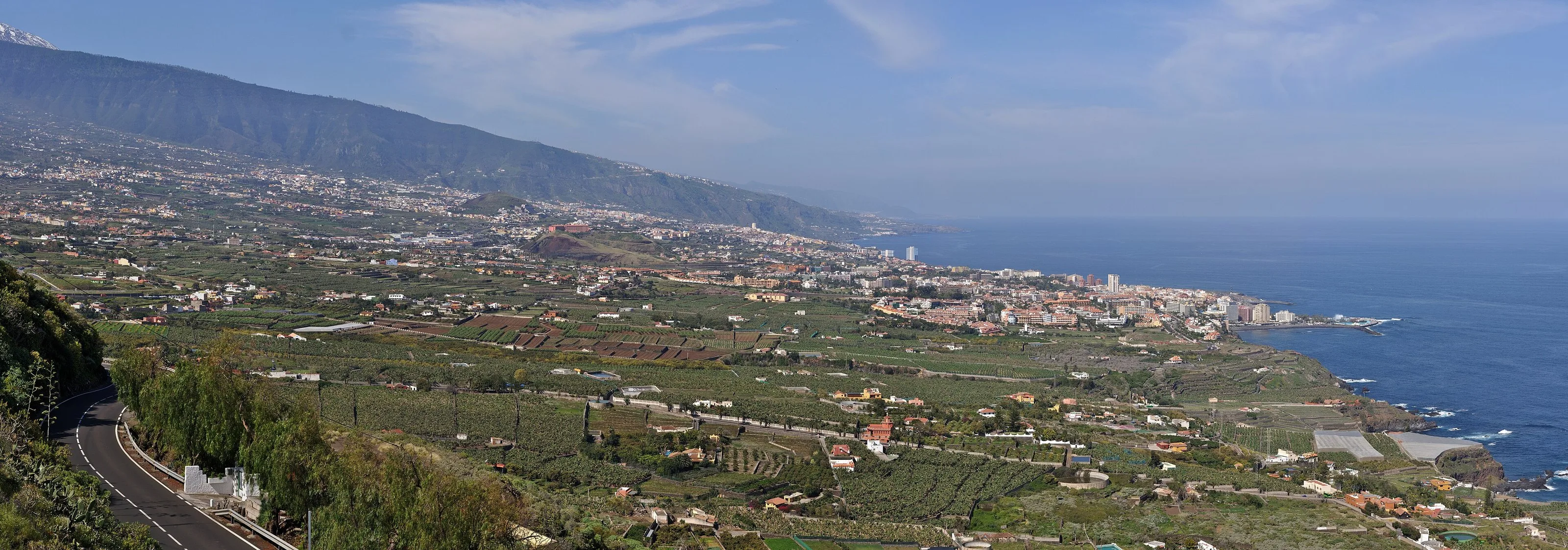
The municipality is the largest on Tenerife, at 207 km², and about 78% of Teide National Park lies within it.
The church of La Concepción
It stands on Plaza Casañas, and Turismo de Tenerife considers it the finest baroque building in the Canary Islands. The present church is the third on the site: the previous one was damaged by earthquakes in the early eighteenth century. Inside are three naves and a marble and jasper tabernacle by Giuseppe Gaggini, from 1823. It has been a National Historic Monument since 1948 and houses a Sacred Art Museum with seven rooms. No official source publishes its opening hours or price.
The Casa de los Balcones
At Calle San Francisco 3. It is a seventeenth-century mansion with a long Canary-pine balcony along its front and a Canarian courtyard with galleries and a wooden wine press. Today it is a traditional crafts centre and a museum of Canarian customs, and it closes on the day of the La Orotava Romería. On the same street, in the Ximénez Franchi house, is the 'Alfombras de La Orotava' ephemeral art centre, and directly opposite both stands the Casa Molina, with a late-Renaissance doorway.
The Town Hall, San Agustín and the Liceo de Taoro
- Town Hall (Carrera del Escultor Estévez 1). Designed in 1869 on the site of the Poor Clares convent of San José. Work was meant to take two and a half years and took 25: it was finished in 1895, in neoclassical style.
- Church of San Agustín (Plaza de la Constitución). Built between 1671 and 1694 over the San Roque chapel. In the nineteenth century the former convent served as an infantry barracks; today it houses the House of Culture.
- Liceo de Taoro (Plaza de la Constitución 6). It was the Ascanio family home before becoming the Liceo's club house; the plans date from 1925. It stands on a rise surrounded by gardens, looking over the valley and Puerto de la Cruz. No official source says whether you can visit inside.
Two free gardens
The Victoria Gardens, beside Plaza de la Constitución, climb in terraces with fountains and flowers. They belonged to the mansion of the Marquisate of La Quinta Roja. At the top is the marble mausoleum built under the French architect Adolph Coquet for Diego Ponte del Castillo, who died in 1880. The bishopric would not let him be buried in the family vault because he was a freemason, and the mausoleum, finished in 1883, stayed empty. From the top you see the whole old town. Entry is free.
The Hijuela del Botánico is behind the Town Hall, on Calle Tomás Pérez. It occupies the old orchard of the Poor Clares convent and began as a nursery for the Botanical Garden in Puerto de la Cruz. It is a small garden behind a cast-iron railing, with rare exotic trees and a dragon tree. It is free as well.
The Ibero-American Crafts Museum
The MAIT, run by the Cabildo, is at Calle Tomás Zerolo 34, in the former Dominican convent of San Benito Abad. It opened as a museum in 1991 and has ten rooms of permanent and temporary exhibitions. Entry is free. It opens Monday to Friday 10:00–15:00 (last entry 14:00) and Saturdays 10:00–14:00 (last entry 13:00). Closed on Sundays and public holidays.
The Corpus Christi carpets
The town marks Corpus Christi with carpets. The procession has gone out on the eighth day of the Corpus Christi festivities since 1700, and the flower carpets began around 1844–1847, according to the town hall's guide. Each year a huge carpet of sand from Teide National Park, in up to 41 colours, covers the Town Hall square. In 2007 Guinness World Records listed it as the world's largest carpet made of volcanic sand. The date changes every year, because it follows Corpus Christi.
- Old town
- Historic-artistic ensemble, Royal Decree 3302/1976 · 2–3 hours for a first visit
- Ibero-American Crafts Museum
- Calle Tomás Zerolo 34 · Mon–Fri 10:00–15:00, Sat 10:00–14:00 · closed Sundays and holidays · free
- Victoria Gardens
- Plaza de la Constitución · free entry
- Hijuela del Botánico
- Calle Tomás Pérez, behind the Town Hall · free entry
- Casa de los Balcones
- Calle San Francisco 3 · closed on the day of the Romería · hours undated on the official page
- La Concepción and Sacred Art Museum
- Plaza Casañas · hours and price not published
From Finca Julia
La Orotava lies east of Icod, in the valley that bears its name. A good plan is to see the old town and its two gardens in the morning, then head down to Puerto de la Cruz. It is all laid out step by step in the valley itinerary. If you fancy the hills, La Caldera recreation area is further up; check the state of its trails in our guide before you go.
La Orotava and Puerto de la Cruz in a day
Things to do in Puerto de la Cruz
Icod or Puerto de la Cruz? Where to stay
Frequently asked questions
How long do you need for La Orotava?
Turismo de Tenerife suggests two to three hours for a relaxed first visit to the old town. The museum and the gardens come on top of that.
What can you see for free in La Orotava?
The walk round the old town, the Victoria Gardens, the Hijuela del Botánico and the Ibero-American Crafts Museum, which charges no admission.
When are the La Orotava carpets?
During the Corpus Christi octave, so the date changes every year. That day the Town Hall square is covered with a carpet of sand from Teide.
Is the Botanical Garden in La Orotava?
No: it is called the La Orotava Acclimatisation Garden, but it is in Puerto de la Cruz. In the town you have its former nursery, the Hijuela del Botánico.
Finca Julia is a few minutes from all of this.
Check availability on Airbnb — Opens the official Airbnb listing in a new tabSources
- Turismo de Tenerife — Centro histórico de La Orotava ↗
- Turismo de Tenerife — La Orotava (inglés) ↗
- BOE — Real Decreto 3302/1976, conjunto histórico-artístico de La Orotava ↗
- Turismo de Islas Canarias — Villa de La Orotava ↗
- Ayuntamiento de La Orotava — Iglesia de la Concepción y Museo de Arte Sacro ↗
- Turismo de Tenerife — Iglesia de la Concepción (inglés) ↗
- Turismo de Tenerife — Casa de los Balcones ↗
- Turismo de Tenerife — Casa de los Balcones (inglés) ↗
- Ayuntamiento de La Orotava — Casa de los Balcones, Centro de Arte Efímero e inmuebles próximos ↗
- Turismo de Tenerife — Ayuntamiento de La Orotava ↗
- Turismo de Tenerife — Iglesia y exconvento de San Agustín ↗
- Turismo de Tenerife — Liceo de Taoro ↗
- Turismo de Tenerife — Jardines del Marquesado de la Quinta Roja ↗
- Turismo de Tenerife — Jardines Victoria (inglés) ↗
- Ayuntamiento de La Orotava — Jardines Victoria y mausoleo ↗
- Ayuntamiento de La Orotava — Hijuela del Jardín Botánico ↗
- Turismo de Tenerife — Hijuela del Botánico (inglés) ↗
- Cabildo de Tenerife (Artenerife) — Museo de Artesanía Iberoamericana ↗
- Ayuntamiento de La Orotava — Guía de las alfombras de La Orotava (PDF) ↗
- ICIA — Jardín de Aclimatación de La Orotava (ubicación y horario) ↗
Updated on: · Reviewed on:
This guide is written from a house in Icod.
Finca Julia is a Canarian house for four in the hills above the town. Availability and price are on the official listing.
Plans
Plans that pass through here
Experiences and itineraries that share places with this page.
- DayThe Orotava Valley, from the old town to the seaThe La Orotava old town, two free gardens, old Puerto de la Cruz, the Botanical Garden and the coast road home past the valley viewpoints. Half an hour from Icod.
- PlanA morning of mystery in IcodA 27,000-year-old lava tube, a tree whose age nobody knows and the port the lava swallowed in 1706. For travellers who come looking for stories.
- PlanA morning among dragon trees and stoneBreakfast in the old town, the dragon tree before the crowds, Icod on foot and Garachico for lunch. Four hours, six kilometres of driving.
- PlanAn afternoon under coverWhen the north does what the north does: Europe's largest lava tube, a church a hundred metres from the dragon tree and a winery. All booked or under cover.
Keep reading
The whole guide
© Javier Sanchez Portero · CC BY-SA 3.0 5 min read
Things to do in Puerto de la Cruz, from the fishing quarter to the 1788 garden
© Javier Sanchez Portero · CC BY-SA 3.0 5 min read
Towns near Icod: north Tenerife, town by town
© -wuppertaler · CC BY 4.0 5 min read
San Cristóbal de La Laguna from Icod: what to see and how to get there
Finca Julia · Icod de los Vinos
And at the end of the day,
the terrace.
An old Canarian house on the hillside, with the Atlantic in front. Availability and price are on the official Airbnb listing.