Practical information
When to visit northern Tenerife
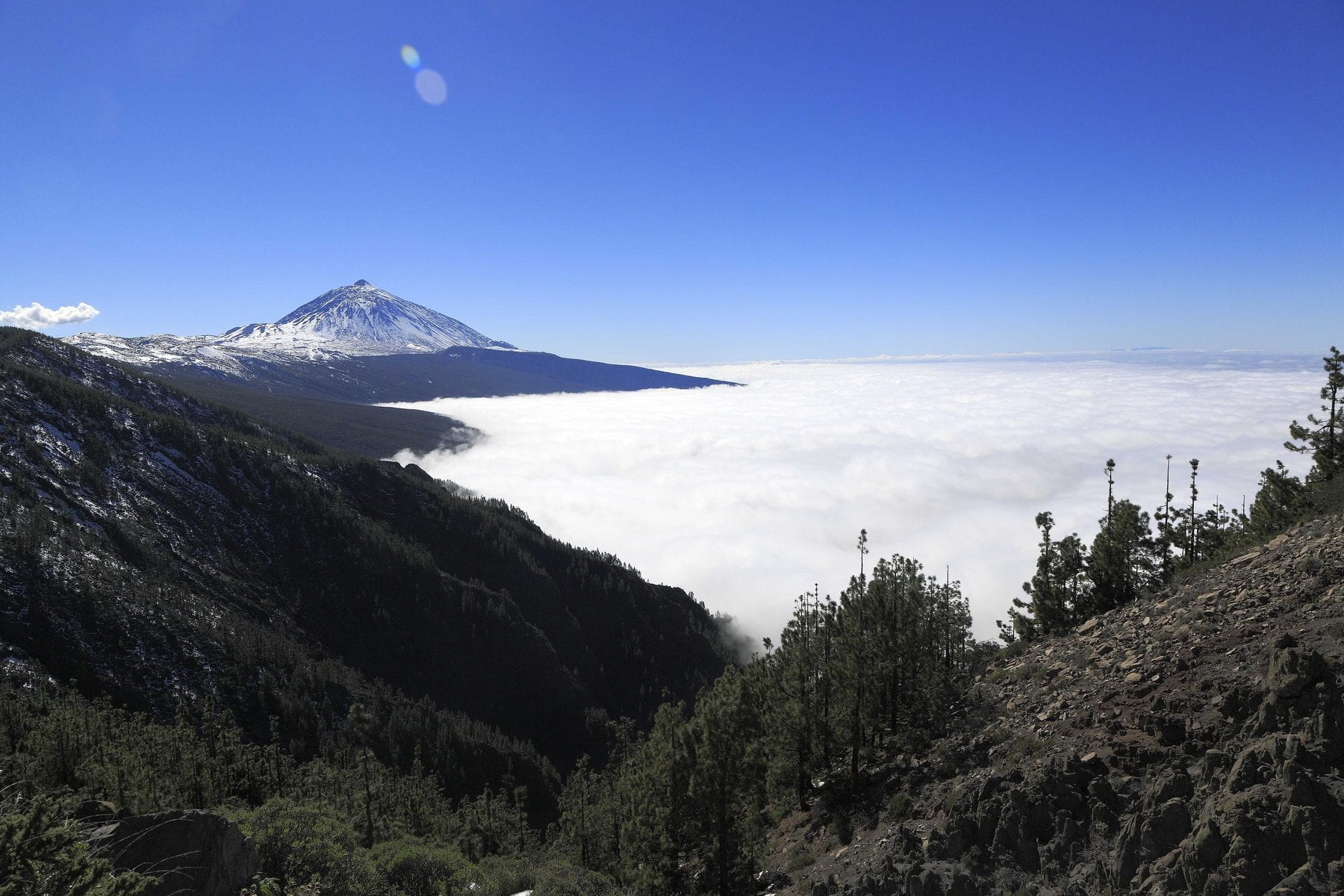
The question everyone asks before booking in the north is whether it rains a lot. The honest answer: more than in the south, and even so the wettest month of the year is around 80 millimetres, which is less than an ordinary April in northern Spain. What actually needs explaining is not the rain, but the cloud.
The 'panza de burro'
It is the layer of low grey cloud that often covers the northern slope, especially in summer. Three things combine: the north-easterly trade winds push damp sea air against the island; a temperature inversion generated by the Azores high acts as a lid that stops that air rising further; and the terrain forces it up to condense right beneath that lid.
From below it is a grey ceiling. From above, up at the summit, it is the sea of clouds that appears in every photograph. The practical consequence for a guest is the most important line on this page: a cloudy dawn in Icod does not mean the day is lost. Climb above the inversion — Teide, Chinyero, the high midlands — or cross to the south, and there is almost always sun half an hour away.
Month by month, with data
These are AEMET's normal values for the Tenerife Norte station, 1981–2010. Important: that station sits at 632 m, and in the town of Icod — lower and further west — temperatures are a little milder and rainfall lower. Use them as a seasonal pattern, not a forecast.
- January
- 13 ºC mean · 16 ºC high · 80 mm
- February
- 13 ºC · 17 ºC · 70 mm
- March
- 15 ºC · 18 ºC · 61 mm
- April
- 15 ºC · 19 ºC · 39 mm
- May
- 16 ºC · 20 ºC · 19 mm
- June
- 18 ºC · 22 ºC · 11 mm
- July
- 20 ºC · 25 ºC · 6 mm
- August
- 21 ºC · 26 ºC · 5 mm
- September
- 21 ºC · 25 ºC · 16 mm
- October
- 19 ºC · 23 ºC · 47 mm
- November
- 17 ºC · 20 ºC · 81 mm
- December
- 14 ºC · 17 ºC · 82 mm
How much sun there actually is
Rainfall is the figure everyone looks at and the one that says least. What decides whether a trip feels grey is hours of sunshine, and AEMET publishes those too. Adding up its twelve monthly means gives around 2,409 sunshine hours a year at the Tenerife Norte station, against the 2,726 AEMET itself gives for Tenerife Sur. The gap is about 317 hours: real, but far smaller than the north's reputation suggests. Roughly six and a half hours of sun a day on annual average against seven and a half.
Month by month, the gap almost vanishes exactly when it matters most. In August the north records 269 sunshine hours and the south 277: eight hours across the whole month. In July the gap is wider, 262 against 295. The months when the north genuinely loses are the winter ones: 137 hours in December against 195, and 150 in January against 193.
What to do with a grey morning
The temperature inversion that makes the ‘panza de burro’ has a ceiling, and you can drive through it. According to the meteorologist José Miguel Viñas, the inversion in the Canaries sits between 1,600 and 1,800 m in winter and between 1,200 and 1,400 m in summer. Above that line there is sun, always. It is why the sea of clouds appears in every summit photograph.
- **Go up.** The Teide road crosses the inversion in under half an hour from Icod. You drive into the cloud and come out above it.
- **Cross over.** The south is a bit over an hour away and almost always clear, especially in winter, when the difference is sharpest.
- **Stay and use it.** The laurel forest, the ravines and Garachico's old town all look better under low cloud than in full August sun, and nobody is there.
- **Wait.** Plenty of grey mornings open up by midday. Before cancelling a beach plan, it is worth looking out of the window at twelve.
So when should you come?
- May and June: probably the best. Dry, mild, fewer people, and the 'panza de burro' has not fully settled in yet.
- July to September: the dry warm months, August the hottest with barely 5 mm of rain. The trade-off is more grey mornings on the coast and more people.
- October: a good mix of warm sea and thinner crowds.
- November to March: rain and cool air, and the odd day with the Teide road closed for ice or snow. It is also when the north is genuinely green and there is nobody on the trails.
- There is no bad season here. There is a season worth understanding before you arrive.
Finca Julia is a few minutes from all of this.
Check availability on Airbnb — Opens the official Airbnb listing in a new tabKeep reading
A week in northern Tenerife
Seven days from Icod, with what must be booked weeks ahead and what you decide in the morning depending on the weather. A real itinerary, not a wish list.
North or south? Where to stay in Tenerife
An honest comparison, including the part that does not suit us. What the north wins, what the south wins, and who each is for.
Tenerife without the crowds: where the queues are not
The island takes millions of visitors and still has places where nobody goes. Which ones, why they stay empty, and what time to arrive.